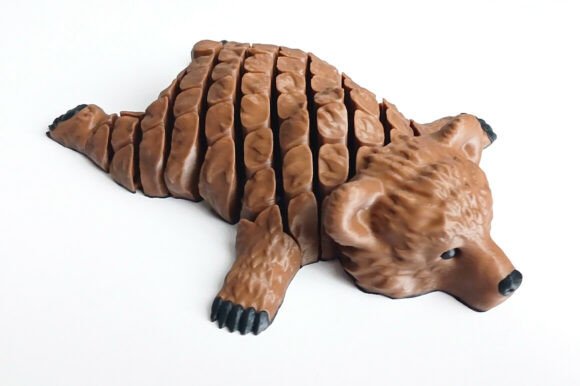
🐻 Articulated Bear - 3D Print Model
In the rapidly evolving world of additive manufacturing, finding a project that balances technical satisfaction with tangible utility is often a challenge. Many enthusiasts find themselves caught between complex engineering prints that require extensive post-processing and simple decorative objects that lack engagement. Enter the 🐻 Articulated Bear - 3D Print Model, a design that seamlessly bridges this gap. This model is not just another figurine; it is a carefully engineered piece of functional art designed to provide immediate tactile feedback while showcasing the capabilities of modern FDM (Fused Deposition Modeling) printers.
Whether you are a hobbyist looking for your first print-in-place success or an experienced maker seeking a perfect multicolor display piece, this articulated bear offers a compelling solution. Its flexible, segmented body allows for natural movement, transforming static plastic into a dynamic object that invites interaction. By optimizing for smooth printing and durability, this model addresses common pain points in 3D printing: failed prints due to support removal, brittle joints that snap under stress, and designs that look good but feel hollow in hand.
Understanding the Design Philosophy
The core appeal of the 🐻 Articulated Bear - 3D Print Model lies in its "print-in-place" architecture. Traditional articulated figures often require assembly, glue, or the tedious removal of internal supports—a process that can ruin the aesthetic of fine details. This bear eliminates those hurdles entirely. The segments are printed as a single continuous unit, connected by precisely calibrated hinges that rely on material flexibility rather than mechanical pins.
This approach serves two distinct purposes. First, it ensures structural integrity. Because there are no weak points created by gluing separate parts together, the bear can withstand significant manipulation without falling apart. Second, it respects the user’s time. For adults seeking practical solutions to downtime or stress, the ability to start a print and have a fully functional toy ready within hours—without sanding or assembling—is invaluable. The clean geometry means no supports are needed, which also results in a smoother surface finish right off the build plate.
Addressing User Needs: From Fidgeting to Display
Why choose an articulated animal over other desk accessories? The answer lies in the intersection of psychology and aesthetics. In high-stress environments, whether it’s a corporate office or a home study, having a physical outlet for nervous energy can improve focus and reduce anxiety. The 🐻 Articulated Bear - 3D Print Model acts as an effective fidget toy. Its satisfying clicking and bending motions provide sensory feedback that helps ground the mind, making it an excellent companion for deep work sessions or creative brainstorming.
Beyond its utility as a stress-relief tool, the bear serves as a statement piece for collectors. The stylized surface design is unique enough to stand out on a shelf yet cute enough to appeal to a broad audience. It works beautifully as a gift for children who love animals, or as a sophisticated desk decoration for professionals. The fact that it requires no assembly makes it particularly suitable for gifting, as the recipient receives a finished product that is ready to play with immediately.
Optimizing for Multicolor Printing
One of the standout features of this model is its optimization for 2-color setups. While many articulated models are monochromatic, the bear’s design highlights specific anatomical features through color separation. Imagine a warm brown body with contrasting cream-colored paws, ears, and snout. This isn’t just cosmetic; it enhances the visual depth of the print, making the articulation points more distinct and the overall form more engaging.
To achieve this, users must plan their filament swaps carefully. The geometry is designed to allow clean transitions between colors without excessive stringing or messy junctions. For those new to multicolor printing, this model serves as an excellent learning platform. It teaches the importance of purge towers and precise timing for filament changes, skills that are transferable to more complex projects. The result is a visually striking object that demonstrates the full potential of dual-extrusion or manual filament swapping techniques.
Practical Implementation and Settings
To ensure the 🐻 Articulated Bear - 3D Print Model performs as intended, adhering to specific printing parameters is crucial. The balance between flexibility and strength depends heavily on how the printer lays down the material. Below are recommended settings to help you achieve the best possible outcome.
- Material: PLA is the standard choice due to its rigidity and ease of use. However, PLA+ or PETG can be used if greater impact resistance is desired, though layer adhesion may need adjustment.
- Nozzle Size: A 0.4 mm nozzle provides the ideal balance between detail resolution and print speed.
- Layer Height: Setting the layer height between 0.16 mm and 0.20 mm ensures that the hinge mechanisms are neither too tight (which could cause breakage) nor too loose (which could lead to wobbling).
- Temperatures: A nozzle temperature of 220 °C and a bed temperature of 65 °C are optimal for PLA. Using a textured PEI plate is highly recommended for easy removal and strong first-layer adhesion.
- Speed: An outer wall speed of 60 mm/s allows for precise extrusion, while travel speeds up to 200 mm/s help minimize stringing between color changes.
- Infill: A 10% gyroid infill pattern provides sufficient internal structure without adding unnecessary weight or material cost.
- Retracting: Set retraction to 0.8 mm at 30 mm/s to prevent oozing during non-printing moves.
- Cooling: Enable 100% fan cooling after the first few layers to ensure crisp details and sharp corners.
- Walls: Use 2 perimeters to strengthen the outer shell and protect the internal infill.
Notably, no supports are required. This simplifies the workflow significantly, allowing you to remove the bear from the build plate and begin testing its articulation immediately. If the hinges are slightly too stiff initially, a gentle flexing motion will loosen them up, revealing their full range of motion.
Who Is This Model For?
The versatility of the 🐻 Articulated Bear - 3D Print Model makes it suitable for various user profiles. For educators, it can serve as a demonstration of mechanical advantage and flexible materials in STEM lessons. For parents, it offers a safe, durable toy that encourages fine motor skill development in kids. For designers and makers, it is a portfolio piece that showcases attention to detail and successful implementation of print-in-place mechanics.
Ultimately, this model succeeds because it respects the user’s intent. It doesn’t demand perfection; it invites play. Whether you are using it to relieve stress during a long coding session, displaying it alongside other collectibles, or teaching someone the basics of 3D printing, the articulated bear delivers consistent value. It transforms the abstract concept of digital design into a tangible, movable, and delightful reality.
Final Thoughts
In a market saturated with generic trinkets, the 🐻 Articulated Bear - 3D Print Model stands out by prioritizing function alongside form. It solves the problem of fragile prints, eliminates the hassle of assembly, and provides a satisfying tactile experience. By following the recommended settings and embracing the potential for multicolor creativity, you can produce a high-quality object that brings joy and utility to your workspace. It is more than just a bear; it is a testament to the thoughtful engineering possible in modern 3D printing.