Nikola Tesla Portrait - 3d Printable
The intersection of historical reverence and modern fabrication technology offers unique opportunities for professionals, educators, and creative entrepreneurs. A Nikola Tesla Portrait - 3d Printable represents more than just a digital file; it is a tangible asset that bridges the gap between abstract scientific legacy and physical presence. For those involved in product design, educational outreach, or personal branding, integrating such a model into a workflow requires understanding not only the technical specifications of the STL file but also the strategic value of displaying iconic figures in three-dimensional space.
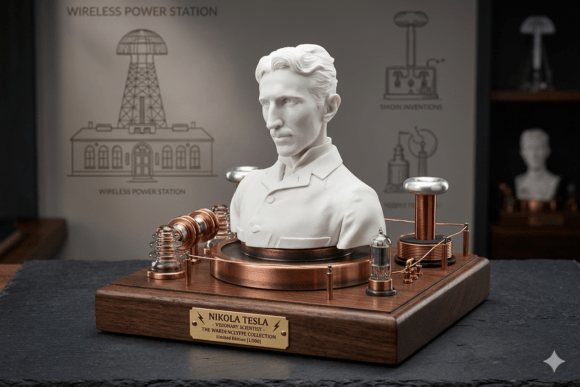
This resource provides an STL file specifically designed for a bust of Nikola Tesla. It is crucial to note that while product images may offer fictional representations for marketing purposes, the downloadable content is strictly the geometric mesh required for slicing and printing. This distinction ensures that users approach the project with realistic expectations regarding resolution, surface detail, and post-processing requirements. The focus here is on practical implementation: how to take this digital asset and transform it into a high-quality physical object that serves a specific purpose in your environment or business.
Understanding the Asset and Technical Foundations
Before initiating any print job, it is essential to evaluate the nature of the source file. An STL (Stereolithography) file contains only the surface geometry of a 3D model, lacking color, texture, or material information. For a detailed subject like Nikola Tesla, whose portrait likely features intricate hair textures, facial contours, and potentially accessories like his signature mustache, the polygon count and mesh integrity are critical. A low-resolution mesh will result in visible artifacts during printing, particularly in fine details, necessitating significant sanding and filling work.
Professionals who prioritize efficiency should verify the manifold status of the STL file before loading it into slicer software. Non-manifold edges, inverted normals, or intersecting faces can cause slicing failures or structural weaknesses in the final print. Using pre-slice analysis tools allows you to identify and repair these issues early in the pipeline, saving time and filament. This step is part of a broader quality control process that applies to all digital-to-physical workflows.
Furthermore, the scale of the bust determines its utility. A miniature bust might serve as a desk accessory or a component in a larger diorama, while a larger scale version could function as a centerpiece for a lecture hall, a maker space, or a corporate lobby. Defining the intended scale early influences decisions regarding printer bed size, support structures, and layer height settings. Consistency in scale is vital if this portrait is part of a series featuring other scientists or historical figures.
Integration into Educational and Corporate Workflows
Educators and trainers often seek methods to make abstract concepts or historical narratives more engaging. Displaying a physical representation of Nikola Tesla in a classroom or training environment can serve as a powerful visual anchor for discussions on electromagnetism, alternating current, and innovation. Unlike static images, a 3D printed bust invites tactile interaction and closer inspection, fostering curiosity among students.
In a corporate setting, particularly within technology firms, engineering departments, or innovation labs, such a portrait can reinforce cultural values centered around ingenuity and forward-thinking. Placing the bust in common areas or meeting rooms can subtly influence the atmosphere, reminding teams of the importance of rigorous experimentation and visionary thinking. However, the integration must be seamless. The print quality must reflect the professional standards of the organization. A poorly finished print may detract from the message, whereas a polished, well-displayed piece enhances the aesthetic and intellectual environment.
For marketers and content creators, this asset offers opportunities for unique storytelling. Behind-the-scenes videos of the printing process, timelapses of the assembly, or comparisons between the digital model and the physical output can generate engagement on social media platforms. These content pieces demonstrate transparency and craftsmanship, resonating with audiences interested in maker culture and industrial design. The key is to align the narrative with the brand’s voice, ensuring that the use of the Tesla portrait feels authentic rather than forced.
Execution Strategies for High-Quality Results
Achieving a superior finish on a complex organic shape like a human bust requires careful planning of the printing orientation. In FDM (Fused Deposition Modeling) printing, layer lines are most visible on vertical surfaces. To minimize this effect, one might orient the bust so that the primary viewing angle aligns with the layer direction, or use supports strategically to allow for easier removal and less post-processing. Alternatively, resin printing (SLA/DLP) offers higher resolution out of the box, making it suitable for smaller, highly detailed busts where surface smoothness is paramount.
Support structure management is another critical factor. Overhangs in the hair and clothing folds will require supports. While tree supports can reduce material usage and improve surface quality by minimizing contact points, they still leave attachment marks that need cleaning. Planning the support placement in the slicer software can significantly reduce post-print labor. For long-term usability, consider designing or selecting models that are self-supporting or have flat bases, facilitating easier display without additional mounting hardware.
Post-processing is where the digital becomes truly physical. Sanding, priming, and painting are standard procedures for achieving a museum-quality finish. However, for busy professionals, time is a scarce resource. If speed is a priority, opting for a monochrome print with a high-quality filament finish—such as matte PLA or PETG—can yield a sophisticated look with minimal effort. Textured filaments can also help hide layer lines, providing a unique aesthetic that embraces the additive manufacturing process rather than trying to conceal it.
Long-Term Value and Maintenance
Once printed, the durability and maintenance of the NFTesla Portrait - 3d Printable depend on the materials used and the environmental conditions. PLA, while easy to print, is susceptible to heat deformation. If the bust is displayed in a sunny window or a warm office, it may warp over time. PETG or ABS offer better thermal resistance, making them more suitable for long-term display in varied environments. UV-resistant filaments can prevent yellowing if the item is exposed to direct sunlight.
Organization of digital assets is equally important for future projects. Keeping a library of verified, repaired, and tested STL files ensures that you can reproduce the bust consistently if needed for multiple locations or replacement parts. Documenting the successful print settings—temperature, speed, cooling, and infill density—creates a knowledge base that improves efficiency for subsequent runs. This systematic approach transforms a one-off print into a repeatable, scalable production process.
Strategic Considerations for Purchasers and Creators
When acquiring a Nikola Tesla Portrait - 3d Printable, due diligence is necessary. Verify the license terms associated with the STL file. Commercial use rights may differ from personal use permissions, especially if you intend to sell prints or use them in client-facing materials. Understanding these legal boundaries protects your business from potential copyright infringement issues.
Additionally, consider the compatibility of the file with your existing hardware. Ensure that the dimensions of the bust fit within the build volume of your 3D printer. If scaling is required, be aware that resizing affects the aspect ratio and may alter the level of detail. Scaling down too much can lose fine features, while scaling up increases print time exponentially. Balancing size, detail, and time cost is a core decision in the execution phase.
Ultimately, the value of this asset lies in its ability to spark connection. Whether it is a student asking about Tesla’s inventions, a colleague admiring the craftsmanship, or a client appreciating the aesthetic of a workspace, the physical manifestation of this digital file facilitates human interaction. By treating the printing process as a structured workflow—from file verification and optimization to post-processing and strategic placement—you maximize the return on investment. This methodical approach ensures that the Nikola Tesla Portrait - 3d Printable is not just another object on a shelf, but a meaningful tool that enhances your professional or personal environment through thoughtful integration and execution.