Potion Bottle Favor - 3d Papercraft Design Guide
In the realm of tactile branding and immersive event design, few elements capture attention quite like a meticulously crafted Potion Bottle Favor - 3d Papercraf. This unique intersection of digital precision and physical assembly offers designers a tangible way to extend brand narratives beyond screens and paper flyers. For professionals in graphic design and visual communication, integrating such creative assets into projects provides a distinct advantage, merging modern aesthetics with hands-on engagement. Whether you are planning a themed corporate event, a fantasy-inspired wedding, or a specialized marketing campaign, understanding the mechanics behind these 3D papercraft models is essential for achieving a polished, professional presentation.
The Role of 3D Papercraft in Modern Visual Communication
While digital marketing dominates the landscape, the psychological impact of holding a physical object remains powerful. A Potion Bottle Digital Files set allows brands to create memorable touchpoints that reinforce identity through interaction. From a design perspective, this format requires a keen eye for visual hierarchy and spatial composition. The challenge lies in translating a flat vector layout into a three-dimensional form that maintains structural integrity and aesthetic appeal.
This process enhances user experience by inviting audience participation. Unlike passive consumption of social media graphics or web design elements, assembling a papercraft model creates an emotional connection. It transforms a simple favor into a keepsake, thereby increasing the longevity of brand recall. For marketers and creators, this represents a strategic opportunity to elevate standard branding efforts into experiential design.
Technical Specifications and Assembly Insights
To execute this project successfully, one must appreciate the technical constraints and opportunities presented by the file formats. The Potion Bottle Favor - 3d Papercraf typically comes with comprehensive digital files, including PDF, DXF, EPS, PNG, and JPG formats. These variations ensure compatibility across various design workflows, from vector editing software like Adobe Illustrator to raster-based applications.
- Assembling Time: Expect a dedicated window of 2 to 3 hours. This duration allows for careful scoring and precise gluing, ensuring the final product reflects high-quality craftsmanship.
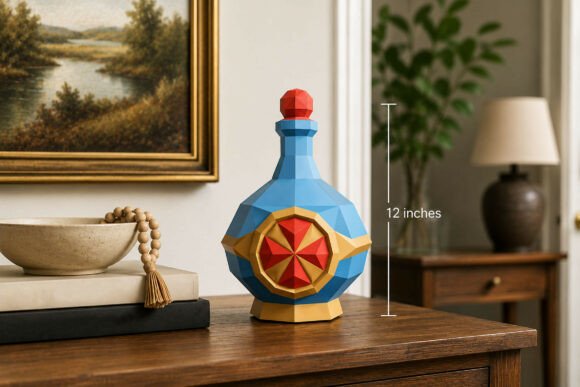
- Assembled Size: The final dimensions are approximately 30 x 22 x 22 cm. This substantial size makes it a statement piece suitable for table centerpieces, shelf displays, or promotional giveaways.
- File Versatility: The inclusion of DXF and EPS files is crucial for print design professionals, allowing for scalable adjustments without loss of quality.
Essential Tools for Professional Results
Achieving a premium finish requires more than just printing the templates; it demands a methodical approach to material handling. The success of your creative projects often hinges on the tools used during the assembly phase. Using the right equipment ensures clean lines and secure bonds, which are vital for maintaining the illusion of a solid glass bottle.
You will need the following resources to proceed effectively:
- Colored Printer: Essential for rendering the intricate details and color palette of the potion label and liquid effects.
- CARDSTOCK PAPER: Opt for a weight that provides rigidity but remains foldable. Standard printer paper may lack the durability required for a 30cm structure.
- Craft Knife & Scissors: Precision cutting is non-negotiable. A sharp craft knife ensures clean edges, preventing fraying that can detract from the modern aesthetics of the design.
- Scorer or Bone Folder: These tools are critical for creating crisp creases. Proper scoring prevents cracking and ensures the folds align perfectly.
- Glue: Use a clear-drying adhesive that bonds well with cardstock without warping the paper.
- Ruler & Non-working Ball Point Pen: Useful for measuring and scoring lightly before cutting.
Integrating Papercraft into Broader Design Strategies
The application of 3D papercraft extends beyond novelty items. In packaging design, similar principles of unfolding and folding are applied to create interactive unboxing experiences. By studying how the Potion Bottle template manages its flaps and seams, designers can gain insights applicable to UI/UX design and interactive web elements. The logic of transforming 2D interfaces into intuitive 3D interactions is a valuable skill in today’s digital-first environment.
Furthermore, this project serves as an excellent exercise in typography and color theory. The label area of the potion bottle is a focal point where text legibility and graphical balance must coexist. Designers can experiment with different font pairings and color palettes to see how they translate onto curved surfaces. This practical experimentation can inform broader decisions in logo design and editorial design, where consistency and readability are paramount.
For those looking to enhance their design workflow, incorporating physical prototyping alongside digital mockups can provide a deeper understanding of scale and proportion. The Potion Bottle Favor - 3d Papercraf is not just a craft project; it is a study in spatial design and material interaction. By mastering the assembly and appreciating the underlying design logic, creators can produce work that is both visually stunning and functionally sound. Ultimately, thoughtful design choices—whether digital or physical—elevate communication, turning ordinary moments into extraordinary brand experiences.